Loading page
Loading page
Everyday fluids are designed for commuting, emissions rules and long service intervals. Race fluids are designed for the track.
VP sells oil, coolant, brake fluid and track prep in Europe as well as fuel. The reason has less to do with range than with who kept asking.
Every blend VP makes started with a complaint: an engine that nothing on the shelf could feed. The rest of the catalogue started the same way, one component further along.
A race fuel's job ends in the combustion chamber. What it leaves behind does not. More cylinder pressure and more timing mean more heat in the oil, more load through the bearings and the gearbox, more temperature in the cooling system, and a car arriving at the braking zone faster than it did last season. A team that finds power in the fuel finds the next weakest part of the car soon afterwards.
Read the full story →Built to pass road-car specifications such as ACEA and API. Priorities are long drain intervals, fuel economy and protecting the catalytic converter, which limits how much zinc and phosphorus anti-wear additive it can carry.
Built for sustained high temperature, high RPM and high cylinder pressure. Anti-wear chemistry is chosen for protecting the engine rather than for emissions hardware, and the viscosity is formulated to hold up under shear. Changed more often, because it works harder.
Designed for road gearboxes and differentials under normal loads, often for long service lives.
Designed for the shock loads and heat of launches, hard shifts and race differentials.
Glycol-based antifreeze, designed for freeze protection and long life.
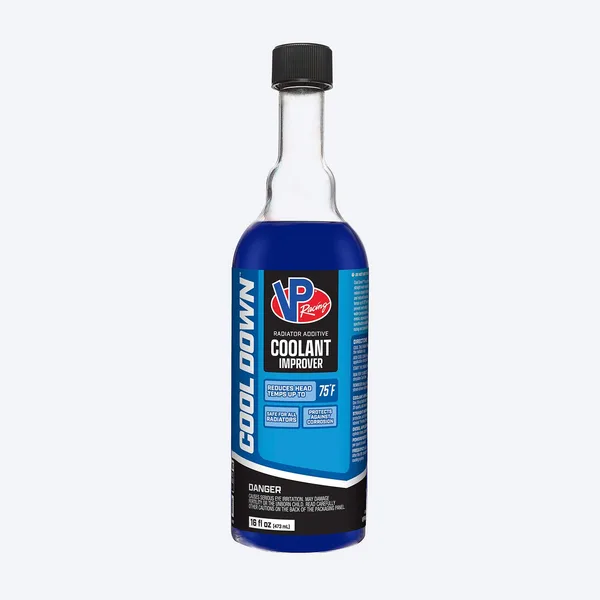
Many series and circuits restrict glycol coolant because a spill makes the track dangerously slippery. Race coolants and cooling additives are built to be circuit-friendly and to move heat out of the engine efficiently.
Meets minimum road standards (DOT ratings) and is typically changed every couple of years.
A higher boiling point to resist fade under repeated hard braking, and changed far more often, because brake fluid absorbs moisture and loses boiling point over time.
Track prep is different again: traction compound is the fluid on the track itself, not in the car, laid down before racing to give tyres something to grip. Track prep →
Full throttle from a standing start, with the whole run at or near maximum load.
Sustained high RPM for a full stint, not a school run's worth of short trips.
Small-capacity engines run hard, often air-cooled, for the length of a moto.
The same fluid across a weekend's worth of weather a circuit season never sees.
Older engines and high static compression ratios that a modern road oil was never specified for.
Forced induction, remapped power and track days that take a road car past what it left the factory doing.
Why VP makes three octane boosters, not one: Octane Booster and Octanium Unleaded restore lost octane, Octanium unleashes past pump fuel.
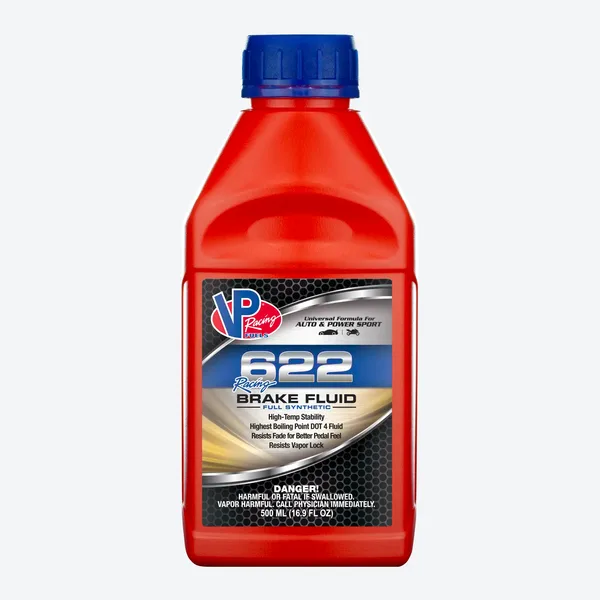
Performance fluidsVP 622 racing brake fluid: a full-synthetic DOT 4 with a 204°C wet boiling point, built to resist brake fade and vapour lock under hard braking.
Performance fluidsWhy VP Racing built glycol-free, track-legal racing coolant: how Stay Frosty and Cool Down lower engine temperature and free up safer ignition timing.
Performance fluidsWhy VP Racing builds its own high-zinc racing oil: the engineering behind Pro Grade and Hi-Performance oils, for engines street oil can't protect.
In some engines it is physically possible, but racing oil is not formulated for it. It is built for sustained high temperature and high RPM rather than for protecting a catalytic converter or for a long service interval, and it is typically changed far more often than a road oil. Check your vehicle's manufacturer requirements before changing what it runs.
Glycol-based antifreeze is extremely slippery when spilled on a track surface, which is a hazard to every car and rider on it. Many circuits and championships require a coolant or cooling additive that is glycol-free for that reason.
More often than the equivalent road fluid, because they work harder. Race oil is typically changed every session or every few sessions rather than over thousands of miles, and race brake fluid is changed more often than the multi-year interval common on the road, since brake fluid absorbs moisture over time and its boiling point drops as a result. Follow the interval documented for the specific product.
It depends on the engine's own specification, how it is used and what your class rules allow. Compare the documented viscosity grade and application of each oil in the range against your engine builder's requirements, or contact us with your engine and application details.
Use Where to Buy to find a dealer, or contact us directly for a trade or team supply enquiry.